
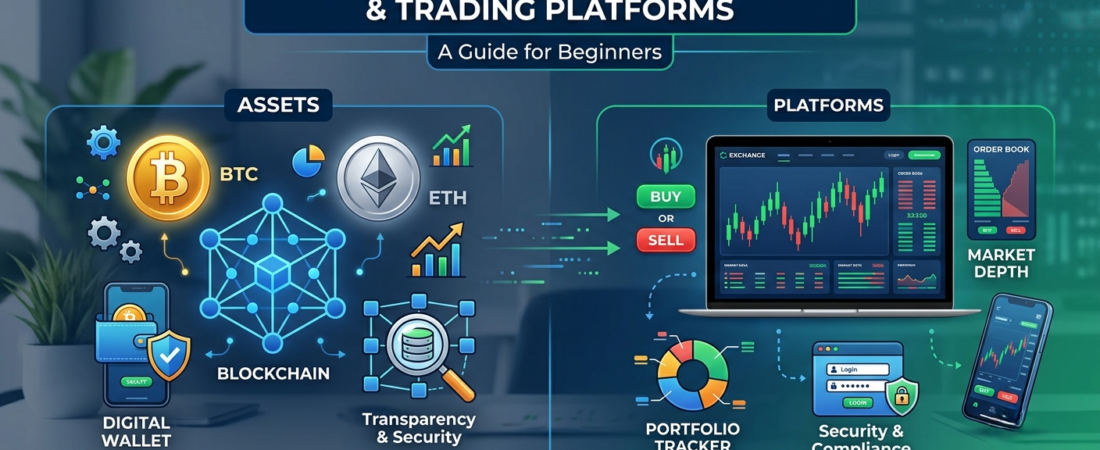
Navigating cryptocurrency can feel like learning a new language. Between blockchain technology, market volatility, and dozens of trading exchanges, knowing where to start can easily overwhelm even tech-savvy investors.
Whether you are looking to buy your first fraction of Bitcoin, trade altcoins, or understand how US crypto tax laws work, having a clear grasp of both digital assets and the platforms that facilitate trades is essential.
1. Cryptocurrency Essentials: How Digital Assets Work
At its core, a cryptocurrency is a decentralized digital currency secured by cryptography. Unlike traditional fiat currencies (such as the US Dollar), most cryptocurrencies operate on distributed networks without central bank oversight.
Key Concepts Every Investor Should Know
- Blockchain Technology: The underlying public ledger that immutably records all transactions across a peer-to-peer network, ensuring transparency and security.
- Bitcoin (BTC): The pioneer cryptocurrency created in 2009, often viewed as “digital gold” due to its limited supply of 21 million coins.
- Ethereum (ETH): A programmable blockchain platform that enables smart contracts, decentralized finance (DeFi), and non-fungible tokens (NFTs).
- Altcoins & Stablecoins: “Altcoins” refer to any cryptocurrency other than Bitcoin (such as Solana or Cardano). “Stablecoins” (like USDC or USDT) are pegged 1:1 to traditional currencies to minimize volatility.
Digital Wallets: Hot vs. Cold Storage
To hold cryptocurrency, you need a digital wallet that manages your public address and private keys:
- Hot Wallets (Software): Connected to the internet (e.g., mobile apps, browser extensions). Convenient for active trading, but higher exposure to online threats.
- Cold Wallets (Hardware): Offline physical devices (e.g., Ledger, Trezor). Highly secure against hackers, making them ideal for long-term buy-and-hold strategies.
2. Centralized vs. Decentralized Exchanges (CEX vs. DEX)
Crypto trading platforms act as the bridge between buyers and sellers. They fall into two primary categories:
┌─────────────────────────────────────────┐
│ Crypto Trading Platforms │
└────────────────────┬────────────────────┘
│
┌───────────────────┴───────────────────┐
▼ ▼
Centralized (CEX) Decentralized (DEX)
- User-friendly interface • Peer-to-peer trading
- Fiat on-ramps (USD bank wires) • No central entity / custody
- Examples: Coinbase, Kraken • Examples: Uniswap, Raydium
Centralized Exchanges (CEX)
Centralized platforms act as trusted intermediaries. They hold your funds in custodial wallets and use order books to pair buyers and sellers.
- Pros: Easy USD bank transfers, high liquidity, user-friendly mobile apps, and robust customer support.
- Cons: You do not hold your private keys; vulnerable if the exchange defaults or suffers an internal security breach.
Decentralized Exchanges (DEX)
Decentralized platforms allow users to trade directly from their personal self-custody wallets using automated smart contracts.
- Pros: Complete self-custody over funds; no account registration or KYC identity checks required.
- Cons: Requires technical know-how; no direct USD bank deposits (crypto-to-crypto trading only); higher risk of smart contract bugs.
3. Comparing Top US Crypto Trading Platforms
If you are based in the United States, choosing a compliant exchange licensed to operate in your state is crucial. Below is a breakdown of top-tier platforms:
|
Platform |
Best For |
Maker / Taker Fees |
Security Features |
Key Highlights |
|
Coinbase |
Absolute Beginners |
~0.40% – 0.60% (Lower on Coinbase Advanced) |
2FA, YubiKey support, insurance coverage for USD balances |
Highly regulated in the US; seamless USD integration. |
|
Kraken |
Low Fees & Advanced Charting |
0.16% / 0.26% (Kraken Pro) |
Proof of Reserves, strict cold-storage protocols |
Industry-leading security track record and robust order book tools. |
|
Gemini |
Compliance & Security |
0.20% / 0.40% (ActiveTrader) |
SOC 2 Type 2 certified, hardware key support |
Strong regulatory standing; SOC-compliant infrastructure. |
|
Robinhood |
Stock & Crypto Combined |
0% Explicit Commission (Built into spread) |
Two-factor authentication, custodial controls |
Great for simple mobile trading alongside traditional stocks. |
4. Key Factors to Evaluate Before Choosing a Platform
Before linking your bank account or depositing funds, review these features:
- Security and Regulatory Compliance: Verify that the platform registers as a Money Services Business (MSB) with FinCEN and adheres to state-level licensing (such as New York’s BitLicense).
- Fee Schedules: Standard retail purchase interfaces often charge convenience surcharges. Always switch to the platform’s advanced trading view (e.g., Coinbase Advanced or Kraken Pro) to lock in lower Maker (liquidity provider) and Taker (liquidity taker) rates.
- Market Depth & Order Types: Advanced traders should ensure the platform offers limit orders, stop-loss orders, and real-time market depth charts to manage execution risk effectively.
5. US Taxes and IRS Reporting Requirements
Cryptocurrency is treated as property by the IRS, meaning almost every trade, sale, or spend triggers a taxable event.
- IRS Form 1099-DA: US-regulated brokers issue Form 1099-DA (Digital Asset Proceeds From Broker Transactions) to report your gross trading proceeds directly to the IRS.
- Capital Gains Taxes:
- Short-Term Capital Gains: Assets held for 1 year or less are taxed as ordinary income (ranging from 10% to 37%).
- Long-Term Capital Gains: Assets held for over 1 year qualify for lower capital gains rates (0%, 15%, or 20%).
- Record-Keeping: Because transferring crypto between self-custody wallets and exchanges can lead to missing cost-basis records, utilizing dedicated crypto tax software to log every transaction is strongly recommended.
6. Actionable Security Checklist for Traders
- Enforce Strong 2FA: Never rely on SMS-based two-factor authentication, which is vulnerable to SIM-swapping. Always use an authenticator app (Google Authenticator, Authy) or a hardware security key (YubiKey).
- Beware of Phishing: Bookmark your exchange URLs. Avoid clicking sponsored search ads or unexpected links sent via email, text, or Telegram/Discord.
- Practice the “Not Your Keys, Not Your Coins” Rule: Keep small trading capital on exchanges for active market orders, but transfer long-term investments into a cold storage hardware wallet.